|
|
|
|
EV Driven is a passionate group of people bringing together the best content on electric vehicles and celebrating the Revenge of the Electric Car. If you would like to participate, please contact: Tony Karrer
|
4194 Articles match "Fuel"
|
The Latest from Electric Vehicles
|
MORE
|
|
Now, For Your Fuel-Efficient Little Green Car, V-8 Sound!
Suppose your fuel-efficient green car actually sounded like a snarling V-8 or V-1 If you drive a small car or, heaven forfend, a hybrid or a clean-diesel, you may have heard the jokes. And the jibes. "Hey, Hey, Mister, how many rubber bands that thing have?"
Green Car Reports
- Thursday, March 11, 2010
Trucks and the irrelevance of hybrid and electric cars
Unfortunately, despite big increases in fuel economy, especially in city traffic (although how many really need a truck in city driving?), The most important vehicle in America? In February, Ford sold almost 33,000 Ford F Series trucks, making it the top selling vehicle in America, by far. Of the top 3 selling vehicles, 2 were trucks.
Hybrid Car Blog
- Thursday, March 11, 2010
University of Wisconsin Team Develops High-Yielding Chemical Hydrolysis Process to Release Sugars from Biomass for Cellulosic Fuels and Chemicals
A University of Wisconsin-Madison research team has developed a chemical process for the hydrolysis of biomass into sugars for subsequent processing into fuels and chemicals that delivers sugar yields approaching those of enzymatic hydrolysis. All told, says Raines, using this integrated process, they were able to convert half of the sugars available in plant biomass into liquid fuel.
In an open-access paper published in the 9 March issue of the Proceedings of the National Academy of Sciences , they report that the process leads to a nearly 90% yield of glucose from cellulose and 70-80% yield of sugars from untreated corn stover.
Green Car Congress
- Thursday, March 11, 2010
|
-
|
The Best from Electric Vehicles
|
MORE
|
-
Is the best hybrid a fuel cell hybrid?
Because it gives Americans what they want Last week, essentially every major automaker issued a joint Letter of Understanding regarding the development and commercialization of fuel cell vehicles. By 2015, these automakers anticipate the capability of producing hundreds of thousands of fuel cell vehicles per year. A couple of years ago I attended an event provided by GM So what? Won't they still be far more expensive than gasoline vehicles, even pure electric vehicles?
Hybrid Car Blog
- Wednesday, September 16, 2009
-
EIA Projects 5% Decrease in Fossil-Fuel-Based CO2 Emissions in 2009; Little Change in Emissions from Gasoline
Click to enlarge. In its current version of the Short Term Energy Outlook ( STEO ), the US Energy Information Administration projects a 5% decline in fossil-fuel-based CO 2 emissions in 2009. decrease in CO 2 emissions from fossil fuels in 2008. An improving economy is expected to increase CO 2 emissions from fossil fuels by 0.7% US CO 2 emissions growth. Source: EIA STEO.
Green Car Congress
- Wednesday, August 12, 2009
-
Study Finds That Higher Ethanol Blends Result in Improved Energy Efficiency in Flex-Fuel Engines, Partially Offsetting Reduced Energy Density of Fuel
Click to enlarge. A study of flex-fuel vehicles operating on different ethanol blends (E10, E20, E30, and E85) found that higher ethanol blend ratios provide better energy conversion within the engine. The E85 fuel blend consumed fewer BTUs per mile than all other
ethanol ethanol fuel blends evaluated.
BTU per hp hr at 65 mph for the four ethanol blends. Source: Hanna et al.
Green Car Congress
- Monday, October 12, 2009
-
-
GM Quantifies CO2 and Fuel Consumption Reductions Via E-REVs And PHEVs, As Compared To Conventional Hybrids
FCEV” refers to all fuel cell vehicles, including E-REVs and fuel cell hybrids. In the paper, the GM team broke down CO 2 and fuel consumption reduction potentials into several categories:
Taking note of pending vehicular greenhouse gas (GHG) regulations such as California’s Assembly Bill 1493 (Pavley), the authors observe that GHG emissions from conventional vehicle powertrains are already regulated to some extent by fuel economy regulations in many countries, and that by Jack Rosebro
Energy sources, paths, storage media, and propulsion
Green Car Congress
- Saturday, May 16, 2009
-
Automakers Issue Joint Statement in Support of Commercial Introduction of Fuel Cell Vehicles from 2015 Onward
Leading vehicle manufacturers in fuel cell technology—Daimler AG, Ford Motor Company, General Motors Corporation/Opel, Honda Motor Co., Hyundai Motor Company, Kia Motors Corporation, the alliance Renault SA and Nissan Motor Corporation and Toyota Motor Corporation— issued a joint a Letter of Understanding (LoU) regarding the development and market introduction of fuel cell electric vehicles.
The signing automobile manufacturers strongly Ltd., These companies have built up extensive expertise in fuel cell technology; the signing marks a major industry step towards the serial
Green Car Congress
- Wednesday, September 9, 2009
-
Study Finds that US Subsidies for Fossil Fuels Are Almost 2.5x Those for Renewables
US subsidies for fuels and renewable energy, 2002-2008. The vast majority of US federal subsidies for fossil fuels and renewable energy from 2002-2008 supported fossil energy sources that emit high levels of greenhouse gases when used as fuel, according to research released on Friday by the Environmental Law Institute (ELI) in partnership with the Woodrow Wilson International Center for Scholars.
The study, “Estimating US Government Subsidies to Energy Sources: 2002-2008”, found that fossil fuels benefited Nuclear was not included in the analysis. Source: Adeyeye
Green Car Congress
- Friday, September 18, 2009
-
-
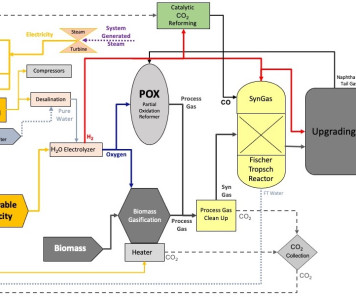
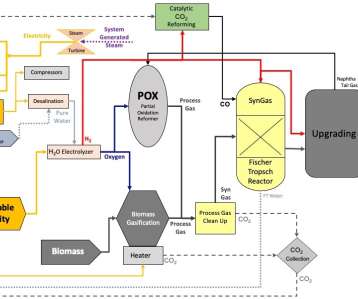
Researchers Propose Solar-Driven Biomass Gasification Pathway for Synthetic Fuel Production
Hertwich and Xiangping Zhang, is to obtain an easy to handle fuel with near-zero CO 2 emission and reduced land-use requirements compared to first and second generation biofuels. The researchers modeled the production of methanol, which can be used directly as transport fuel or as input for DME and FT-diesel synthesis. For comparison, they also modeled the production of methanol using only biomass Schema of synfuel synthesis through solar-driven biomass gasification. Solar energy produces both heat for gasification and H 2 via electrolysis.
Green Car Congress
- Friday, May 1, 2009
-
GM Highlights Engineering Advances With Second-Generation Fuel Cell System and Fifth-Generation Stack; Poised for Production Around 2015
GM’s second-generation fuel-cell system (engineer included for scale.) Click to enlarge. The second generation hydrogen fuel cell system under development by General Motors—which contains its fifth-generation fuel cell stack—is half the size, 220 pounds (100 kg) lighter and uses less than half the platinum (30 grams plus or minus vs. 80 grams) of the current generation in the Chevrolet Equinox Fuel Cell electric vehicle ( earlier post ).
The production-intent fuel cell system can be packaged under the hood in about the same space as a four-cylinder engine; by contrast, the first generation system in the Equinox (with the fourth-generation stack) is about the size of a file cabinet, says Charles Freese, executive director of GM Fuel Cell Activities.
Green Car Congress
- Monday, September 28, 2009
-
Argonne Study Examines Impact of Real World Drive Cycles on Efficiency and Cost of Different PHEV Configurations
Results from a study by Argonne National Laboratory on the impact of real world drive cycles on the fuel efficiency and cost of different plug-in hybrid electric vehicle (PHEV) configurations suggest that while different PHEV configurations all demonstrate great potential for displacing petroleum use (with fuel displacement increasing linearly with available electrical energy), the relative benefits of adding more battery capacity seem to decrease with increasing pack size.
Basic comparison of fuel consumption showed mean values of:
Aymeric Rousseau, program manager at Argonne, presented a small slice of this wide study at the Advanced Automotive Battery Conference 2009 (AABC) this week in Long Beach.
Green Car Congress
- Thursday, June 11, 2009
-
-
Study Finds Cash for Clunkers Program Boosted Average Fuel Economy of All Vehicles Purchased by 0.6 mpg in July and 0.7 mpg in August
Average fuel economy of purchased new light-duty vehicles by month, including projection without the program. Click to enlarge. A study by Michael Sivak and Brandon Schoettle at the University of Michigan’s Transportation Research Institute (UMTRI) concluded that the recently concluded Cash for Clunkers program improved the average fuel economy of all vehicles purchased by 0.6 Generally, the trade-in vehicles must have had fuel economy of 18 mpg or less and be Source: Sivak and Schoettle 2009. mpg in July 2009 and 0.7
Green Car Congress
- Saturday, September 12, 2009
|
|
|